





 Home
HomeCore Muscle: The Foundation for Stability and Performance
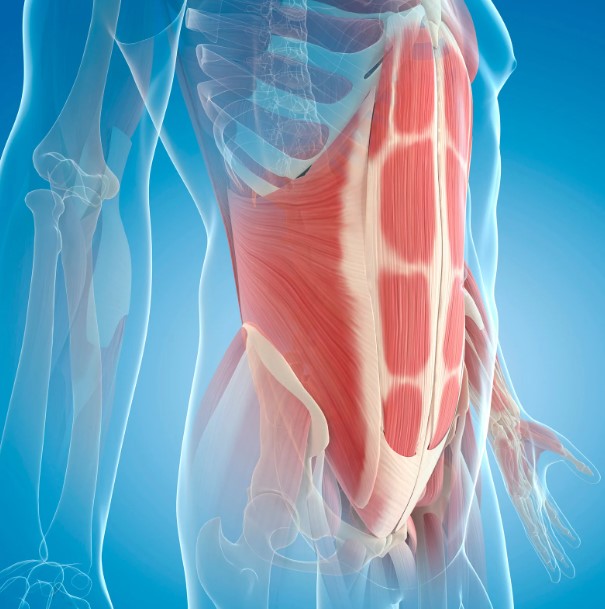
Having a "strong core" isn't just about getting six-pack abs!
Nearly every physical activity you can think of, such as: walking, crawling, lifting, sprinting, balancing, twisting, bending forward and backward, bending sideways, and even breathing are all affected by the strength and function of the core muscles.
Definitions
The term "core muscle" generally refers to the muscles located below the diaphragm and above the pelvic floor muscles. This includes both the superficial and deep layers of the abdominal and lumbar muscles. Their primary roles are to support the torso, provide stability, transfer power between the upper and lower body, and generate intra-abdominal pressure essential for the proper functioning of internal organs.
Analyzing core muscle provides data that can be used to design effective training programs, allowing for targeted strengthening to prevent injury and enhance athletic performance!
Introduction to Core Muscle Groups
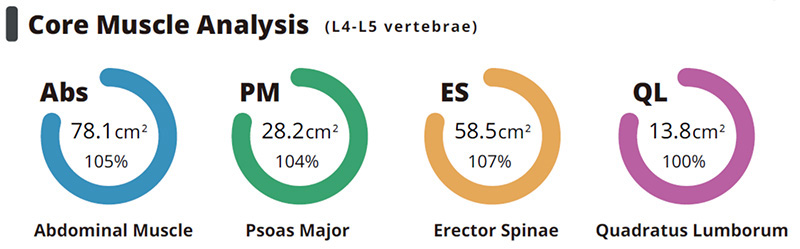
1.Abdominal Muscles (Abs):
These muscles (Rectus abdominis, Transverse abdominis, External oblique, Internal oblique) stabilize the lumbar spine during upright posture, forward and backward bending, and twisting movements. They act as antagonists to the erector spinae muscles.
2.Psoas Major (PM):
This muscle is a primary mover for hip flexion and plays a crucial role in lumbar spine stability, leg lifting, and lower limb balance. It works synergistically with the iliacus muscle, often referred to collectively as the iliopsoas.
3.Erector Spinae Muscles (ES):
This group (erector spinae, multifidus, longissimus, iliocostalis) stabilizes the thoracic and lumbar spine during upright posture, forward and backward bending, and twisting movements. They act as antagonists to the abdominal muscles.
4.Quadratus Lumborum (QL):
This muscle provides lateral stability to the pelvis and helps maintain spinal stability.
How Core Muscle is Assessed and Analyzed
As core muscles are mostly deep muscles, evaluating their development can be challenging. Academic research typically employs CT and MRI for measurement and computer imaging software for quantification, assessing volume or cross-sectional area. Ultrasound is also used as a less invasive alternative for thickness measurement, but these methods are often complex and costly.
Charder's Body Composition Analyzers utilize Bioelectrical Impedance Analysis (BIA) algorithms developed through validation with CT data to quickly estimate the cross-sectional area of core muscles - by referencing established standard values from research databases, it provides rapid insights into an individual's core muscle analysis for both trainers and users.
1. Relationship Between Cross-Sectional Area/Volume and Strength Performance:
Similar to overall muscle mass, while research indicates a positive correlation between higher muscle mass or larger cross-sectional area and strength performance, ultimate strength output also depends on neuromuscular factors and movement technique details.
The core muscles primarily consist of Type 1 (slow-twitch) muscle fibers, making them more geared towards stability and endurance. Endurance training has a limited hypertrophic effect, so resistance training or high-intensity training is more effective for increasing core muscle size.
2. Percentage Comparison Assessment:
Percentage values are based on a "standard" physique as 100%, indicating the degree of muscle development. This standardized result allows for the evaluation of the balance among the four core muscle groups, enabling the planning of training targeting weaker muscles.
3. Core Muscle Score:
The core muscle score is calculated based not only on the percentage size of the core muscles but also in comparison to the percentage of total body skeletal muscle. A higher percentage of core muscle relative to total skeletal muscle results in a higher score.
Scores below 70 indicate a higher risk of sports injuries or chronic pain, while scores above 85 suggest good core muscle capacity, allowing for further enhancement of athletic performance.
4. International Patents:
TWI835111B
JP7345920B1
US 12,419,532 B2
CN116919340A (Pending)
CN116919340A (Pending)

Core Muscle Training:
Once core muscle can be assessed, the areas where additional training is needed can be easily identified! Training methods for different core muscle groups vary slightly. For example, abdominal muscles respond well to multi-angle, high-repetition endurance training, while the erector spinae benefit from weighted training with correct posture. Targeted training for specific muscle groups can improve their recruitment during activity, further enhancing functional capacity in daily life and movement quality during activities!
Conclusion
Training the core goes far beyond just aiming for visible abs. These deep-seated muscles are fundamental to nearly every movement you make, from everyday activities like walking to advanced athletic feats. By utilizing modern assessment tools that move beyond simplistic visual cues, we can gain invaluable insights into the true strength and balance of these vital muscle groups.
Armed with personalized data on cross-sectional area, percentage comparisons, and Core Muscle Score available only on Charder-series Body Composition Analyzers, users can identify specific weaknesses and tailor training to enhance stability and prevent injuries. A strong core isn't just about aesthetics; it's the foundation for a healthier and more active life!