AWGS 2025 Consensus Update - Simplifying Muscle Assessment for Sarcopenia Diagnosis
As the elderly population grows, the need for early detection and intervention to stave off sarcopenia is more important than ever. The Asian Working Group for Sarcopenia (AWGS) has been an authoritative source for defining and diagnosing sarcopenia, and their 2025 consensus update has revised the diagnostic procedure to make it more streamlined and easier to utilize, emphasizing early detection.
Whereas the focus before was primarily diagnosing sarcopenia in older adults, the shift is now to promote lifelong muscle health, starting in middle age. The need to comprehensively evaluate both muscle mass and strength is greater than ever, and in this article, we’ll summarize the key points of AWGS 2025, and how tools such as Charder’s Body Composition Analyzers and Grip Strength Dynamometers can assist professionals complete diagnosis using the new standards.
1. Simplified and earlier diagnosis of sarcopenia
Sarcopenia is defined as “the age-related loss of muscle mass and function”, and is linked to serious health risks like falls, functional disability, and chronic diseases. The AWGS update recommends two key changes to how sarcopenia should be diagnosed:
Two-Step diagnosis
To be diagnosed with sarcopenia, the subject now only needs to demonstrate:
(1) Low Muscle Mass (the quantity of muscle) and (2) Low Muscle Strength (the quality of muscle)
Notably missing compared to the 2019 version are measures of physical performance, like how fast you walk or how quickly you can stand up from a chair. These are now considered an outcome of poor muscle health, not a starting point for diagnosis, because by the time such measures of physical performance are affected, it may already be too late. The new focus is on detecting low mass and strength earlier, before they develop into major mobility problems.
2. Age for concern now starts at 50
The AWGS now has defined specific cut-off values for middle-aged adults (ages 50–64). This formal inclusion means that doctors can now identify and intervene in a person’s 50s and early 60s, giving them a crucial head start on prevention of muscle and strength loss, in alignment with the understanding that muscle isn’t just as tissue for movement, but as a vital organ that plays a crucial role in overall healthy aging, supporting better metabolism, stronger bones, and even cognitive well-being as it interacts with other organs.
3. Key tools for proactive muscle health
Since the new diagnosis hinges on Muscle Mass and Muscle Strength, objective measurement using certified devices is now more important than ever!
Measurements of muscle strength, muscle mass and physical performance in the AWGS 2025 consensus
| Measurement | Cut-off values | ||||
| Adjustment | Age 50-64 years | Age ≧ 65 years | |||
| Muscle Strength | |||||
| Handgrip (kg) | <34.0 kg | <20.0 kg | <28.0 kg | <18.0 kg | |
| Muscle Mass | |||||
| DXA | ASM/height2 (ASMI) | <7.2 | <5.5 | <7.0 | <5.4 |
| BIA | ASM/height2 (ASMI) | <7.6 | <5.7 | <7.0 | <5.7 |
| DXA | ASM/BMI | <0.80 | <0.55 | <0.73 | <0.52 |
| BIA | ASM/BMI | <0.90 | <0.63 | <0.83 | <0.57 |
| Physical performance (outcome) | |||||
| Five-times chair stand test (seconds) | ≧10.0 | ≧10.0 | ≧12.0 | ≧12.0 | |
| Gait speed, 6-meter walk test (m s) | <1.2 | <1.2 | <1.0 | <1.0 | |
Adapted from: Chen, L., Hsiao, F., Akishita, M., Assantachai, P., Lee, W., Lim, W. S., Muangpaisan, W., Kim, M., Merchant, R. A., Peng, L., Tan, M. P., Won, C. W., Yamada, M., Woo, J., & Arai, H. (2025). A focus shift from sarcopenia to muscle health in the Asian Working Group for Sarcopenia 2025 Consensus Update. Nature Aging.
If a subject’s measurements fall below these thresholds, or if they have pre-existing conditions like diabetes or chronic kidney disease, they should be considered "at risk" and should start intervention to address sarcopenia immediately.
The good news is that muscle health is highly modifiable. The consensus emphasizes multimodal interventions as the best path forward, combining strength training via resistance exercise, and adequate protein intake and nutritional supplementation (like essential amino acids) to properly fuel muscle maintenance and growth.
4. How Charder’s devices are used for Sarcopenia Assessment
Bioelectrical Impedance Analysis (BIA) is a recognized tool for measurement of skeletal muscle (which is needed to derive arm and leg muscle - Appendicular Skeletal Muscle - used in the diagnosis). Compared to DXA, BIA is faster and safer, making BIA devices like Charder Body Composition Analyzers a practical option for usage in clinics, health programs, and general fitness evaluation.
1) Measurement of Skeletal Muscle
AWGS 2025 provides two standards for evaluation of Skeletal Muscle:
Appendicular Skeletal Muscle Index (ASMI)
ASMI normalizes muscle mass with height, providing a standardized metric for evaluating sarcopenia risk. This result can be found directly displayed on the Result Sheet:
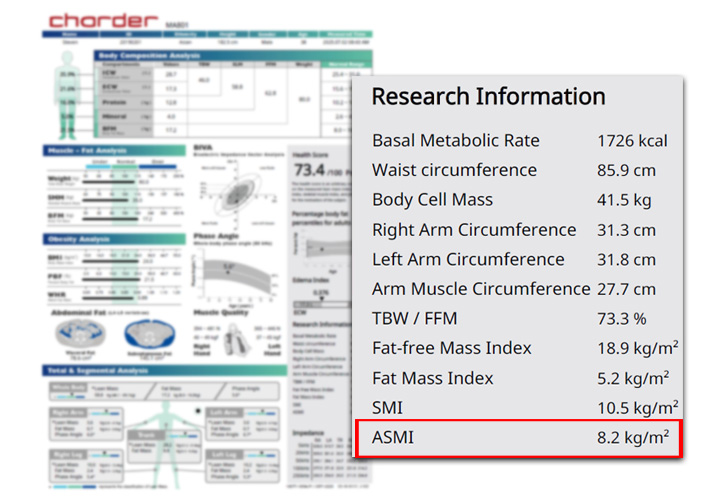
(MA801 Medical Result Sheet used as example)
Appendicular Skeletal Muscle / Body Mass Index (ASM/BIA)
ASM/BIA normalizes muscle mass with BMI, which serves a similar purpose as ASMI for evaluation of sarcopenia risk. However, in addition to height, it also takes into account the subject’s overall weight. Both ASM and BMI can be found on the Result Sheet.
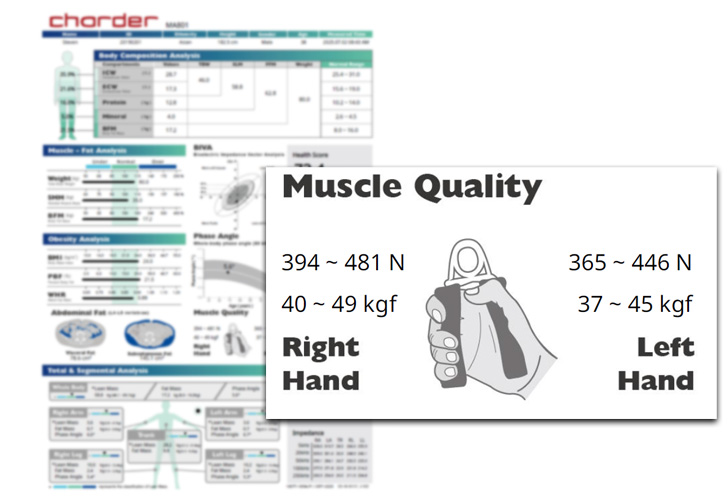
2) Estimation of Grip Strength
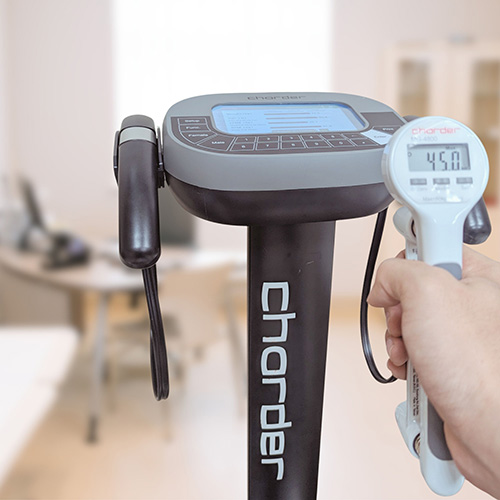
Charder’s professional Body Composition Analyzers uniquely provide a Grip Strength estimation function. This is particularly useful for clinics that may not regularly include grip strength measurement as part of their service; if the estimated grip strength declines continuously, it’s an important warning sign to get a functional test using a dynamometer.
3) Measurement of Grip Strength
For physical measurement of grip strength, a dynamometer should be used. Most dynamometers on the market use a fixed-grip for simplicity (ex: the diagnostic variant of the Charder MG4800), though versions with compressible spring grips (ex: the rehabilitation variant of the Charder MG4800) provide a movement pattern that more closely resembles actual grip motion; both types are great options.

Summary
The AWGS 2025 update is a clear mandate: start measuring muscle health now. By tracking muscle mass and estimated muscle strength with a Charder Body Composition Analyzer, and confirming actual strength with a Charder Grip Strength Dynamometer, subjects and practitioners gain the critical data needed to prevent decline and build a foundation for a healthy, functional life.